
The Power of Personal Responsibility
How Awareness Shapes Relationships and Performance
Jan 6, 2026
4 Mins
Most of us want better relationships, more success in our careers, or progress toward our personal goals. But even when we know what we want, we can still feel stuck or frustrated. Often, the missing piece is personal responsibility; the way we manage our own thoughts, emotions, and reactions before trying to manage anything else.
What Is Personal Responsibility?
Personal responsibility is not about blaming yourself for every problem or feeling pressure to be perfect. It’s about owning your part in the outcomes of your life, noticing how you show up, and making intentional choices that align with what you truly want.
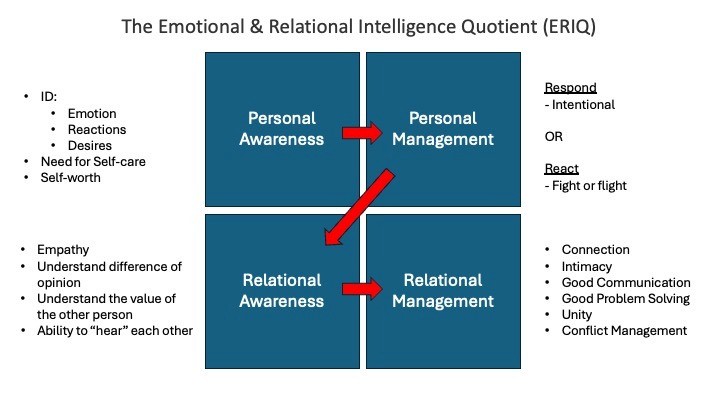
I like to explain this through a model I call E.R.I.Q., the Emotional Relational Intelligence Quotient. It has four quadrants that describe how we interact with ourselves and others. While it can apply to many areas, relationships are a great place to start because they make these dynamics very visible.
Relational Management and Conflict
The lower right quadrant of E.R.I.Q. is relational management. This is where we handle conflict, navigate differences, and work toward deeper connection. Conflict happens whenever two people bring their own ideas and perspectives to the table. And yes, it can feel uncomfortable. But it isn’t inherently bad. In fact, conflict can be a tool for growth.
For example, I recently had a disagreement with my wife. We had different ideas. Naturally, emotions came into play and yet, I am grateful for her perspective. She helps me see when I might be missing something or making a mistake. Without her, I could “walk off a cliff” without even noticing.
When both people in a relationship take responsibility for their reactions, conflict can strengthen connection and intimacy instead of weakening it. This principle also applies to teams, work projects, and personal goals. How we respond matters more than the conflict itself.
Goal Setting and Performance
Relational management doesn’t only apply to relationships. The same ideas help when we are working toward a goal. Whether it’s a career milestone, a fitness goal, or a creative project, the questions are the same:
Where am I trying to go?
What experience am I seeking?
How do I want to show up in pursuit of it?
Your ability to reach those goals depends on how you manage yourself. Awareness of your emotions and intentions, and choosing how to respond rather than react, makes all the difference.
Personal Awareness: The Starting Point
Before you can respond intentionally in relationships or toward your goals, you need personal awareness. This is the ability to notice what’s happening inside you: your thoughts, emotions, and bodily sensations. Without awareness, your nervous system can take over without you realizing it. You might react impulsively, feel triggered, or act in ways that sabotage what you want.
From awareness comes personal management. This is the ability to respond intentionally. A response is deliberate, calm, and thoughtful. A reaction is automatic, often driven by fear, fight or flight impulses, or emotional overwhelm.
The process looks like this: notice what is happening, respond intentionally, act toward your goal, and move closer to the experience you want.
Fear: The Hidden Barrier
One of the biggest obstacles to personal responsibility is fear. Fear shapes our thoughts, emotions, and actions, often in ways we don’t even notice.
One common fear is the fear of not being enough. It can appear in relationships, work, or personal pursuits. Recognizing it is the first step toward responding differently.
For example, I know that I am not personally good enough to play in the NBA. That is a fact, and it does not emotionally activate me because it is irrelevant to my goals. Other fears that matter to me such as failing at parenting, relationships, or work, can trigger strong emotional reactions. When those feelings show up, personal responsibility means noticing them, understanding their impact, and choosing how to respond instead of reacting automatically.
Why Responsibility Feels Liberating
Taking personal responsibility can feel heavy at first because it asks us to look inward, but it is actually freeing. When you are aware of your emotions, intentional about your responses, and mindful in your relationships and goals, you can navigate challenges more effectively. Conflict becomes manageable. Goals become achievable. Relationships become deeper and more connected.
The path is simple but powerful: notice yourself, own your part, and respond intentionally. When you do, fear loses its grip, and you can engage with life fully, meaningfully, and peacefully.
Take Action Today
You do not have to wait for the perfect circumstances to start practicing personal responsibility. Begin by noticing one small area of your life where fear or reactivity is getting in the way. Take a moment to pause, reflect, and choose a deliberate response.
Start small. Reflect daily. Notice your emotions without judgment. Over time, these small choices add up, creating stronger relationships, clearer goals, and a more empowered way of living. Your next step toward transformation is simply awareness and intention. Begin now, and watch how your life changes.
If you want support in applying these principles to your own life, relationships, or goals, reach out to me at chrisbruton.com to start taking intentional action today.